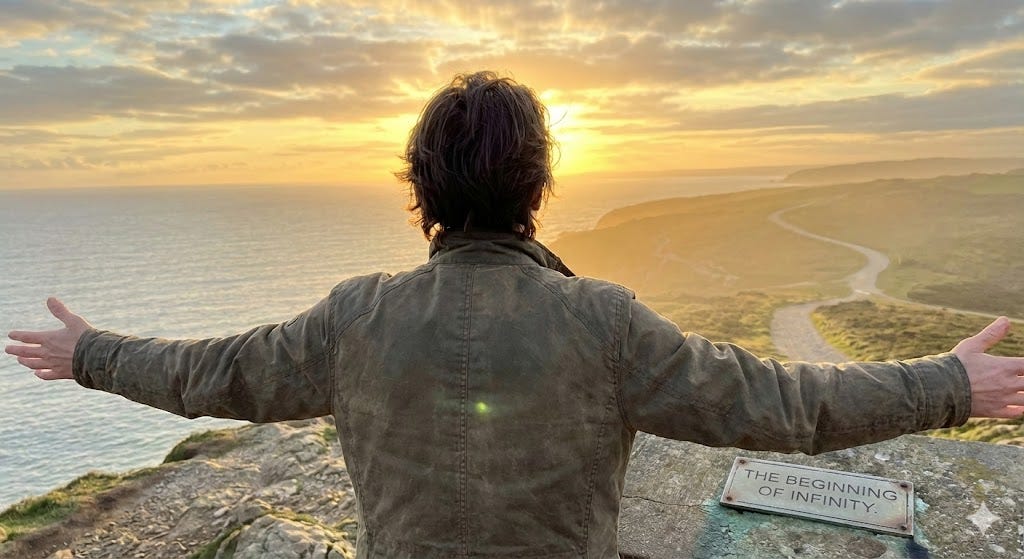
Reflections on knowledge, learning, and human's role in the age of AI
Below is the collection of notes produced during August-November 2025, inspired by reading the book The Beginning of Infinity by David Deutsch.

The book left a long lasting impression on me, and imbuded me with hope about the future.
What is knowledge actually? One definition is it’s a shortest path between point A to point B. Say you need to achieve a certain result, and knowledge provides an answer on how to achieve it. Another definition is knowledge is an explanation, which in turn enables transformation. Natural metals existed for millennia, but our ancestors lacked the knowledge how to transform it into production tools and materials.
David Deutsch in his seminal book “The Beginning of Infinity” is claiming that scientific theories, knowledge, are explanations: assertions about what is out there and how it behaves. At the same time, if you think that every theory should be tested or experienced to be true, then you are falling into a trap of empiricism, a false conviction about the necessity to test things for them to be true. On the contrary, scientific explanations are about reality, most of which does not consist of anyone’s experience.
But what is needed to make a new scientific discovery? Deutsch claims that the process of such discoveries is an act of creativity. To create a good explanation, ideas should be first conjured up - made up or guessed essentially - by people, after which they can be criticized and tested. Direct experiences often misguide people in creating good explanations. Deceptively, the earth feels flat and not moving, but only a good explanation can describe its true nature - being round and spinning in space. So here Desutch makes a jab into post-modernist, who reject any truth and claim there is no such thing as objective truth.
In the process of guessing theories during a creative process, humans are viewed as universal explainers, and our creative powers are required to come up with ideas. You cannot simply read nature like a book, because you may look at the sky and “read” the dots in the sky for a lifetime, or many lifetimes, without learning anything about what they really are. Stars have been there with humans for millennia, but we only understood what they are after a number of good explanations were guessed, criticized and tested.
Good explanations should also be hard to vary. This means that if you change just one part, the explanation no longer fits what we observe. Take germ theory as an example. It says that many diseases are caused by microscopic organisms that multiply inside our bodies. The idea of germs, if believed, causes a whole network of consequences. For example, it explains why diseases are contagious, why there’s an incubation period, why handwashing and sterilizing instruments reduce infections, why vaccines work, and why antibiotics only work on some illnesses but not on viruses. All these pieces hang together and support each other.
Now, if we try to “vary” this explanation by replacing germs with “bad air” or “curses” as the cause, then the tight fit with reality starts falling apart. Bad air doesn’t explain why some people in the same room get sick and others don’t, why specific vaccines prevent specific diseases, or why antibiotics work on bacterial infections but do nothing to a cold. Those variations can’t simultaneously explain the full pattern of facts.
So a good explanation is like a delicate harmony of many ideas that are logically linked together. Germ theory works so well because its parts are hard to vary without breaking its grip on reality. Good explanations stand in the way of understanding and not understanding, it is a difference between feeling stuck looking for a solution and a feeling of discovering the reason for a problem that caused such an unpleasantness of not knowing in the first place. Only in hindsight the solution to a problem seems so obvious, but only because you know the solution, which is essentially an explanation, now.
There are two ways to learn something: one is through your own experience and another to learn something vicariously, which means to learn something through experiencing it in the imagination through the actions of another person. In other words, you either learn from your own lessons or through others’, and each method has its advantages. Let’s first look at learning through your own experience.
The most intuitive way to learn is by starting to do something. When a learner encounters a knowledge gap or a bottleneck because they don’t know how to proceed with a practical task, this creates, in Deutsch’s words, an “emotional request” for understanding. This practical need for understanding prompts a learner to actively seek answers, whether through courses, AI tools like ChatGPT, or Google.
The crucial insight is that when you have such an emotional request, you will remember forever that this works this way, because the knowledge is directly tied to a tangible problem that prevented progress. If something didn’t work for you, this personal failure becomes a powerful motivator for learning and retention. This contrasts with learning in isolation from reality, where theoretical knowledge, while nice to know, is not retained as effectively because it lacks a practical context and emotional connection.
When I write for learning and to understand, I don’t use AI, because then ideas don’t stick.
Deutsch provides a very interesting insight into what it means to be curious: to be curious about something is believing that our existing ideas do not adequately capture or explain it. Consider this: if something is known to you, you will not spend time understanding it, as you already know how it works. This echoes Paul Graham’s advice of following your own curiosity when building something, as it would be something that is new to you, and, hopefully, to the world.
Thinking in terms of good explanations is essential not just for the big stuff, like stars and the universe, but it’s how we do our daily work. When faced with a poor software system performance, you, as a developer, have existing explanations for it but they are in conflict with each other. When you experience conflicting ideas about why the bug exists, you have a problem. Solving a problem, it follows, means creating an explanation that does not have the conflict. Since explanations can contradict each other (in your head), but there are no contradictions in reality, the problem that you experience signals that your knowledge must be flawed or inadequate.
In this picture of the world, humans are viewed as universal explainers who are using their creative abilities to come up with ideas, explanations for the endless problems they encounter. One of them is global warming, for example. This kind of problem cannot be solved by inaction, for example, by using less energy or simply reducing flying, but it can be solved by coming up with new solutions to current problems, such as inventing aircraft that use alternative fuel, or designing scalable carbon-capture systems that remove CO2 directly from the atmosphere. All of this requires even more energy initially, but it leads to progress in the long term.
We should be cautious about living “sustainably” as in a sense of not striving to work on hard problems, or looking for simple solutions to hard problems. Instead, living sustainably can mean embracing change and progress and daring to conjure up atypical solutions. Maybe that’s what the start up scene is doing in some parts of the world.
Realizing that we are in any given moment at the beginning of infinity bears several implications. First, that the stream of new problems is endless, despite our subjective feeling of the end of history. In return, this implies that a stream of solutions - new theories, explanations, startups and companies - is endless as well, because humans can’t help themselves but enjoy solving a hard problem.
Second, whatever you think you know is infinitely small in comparison to what you don’t know. Imagine this: let’s say, the amount of things - explanations - you know is 1000. The amount of things ChatGPT knows is 10 trillion (13 zeros). By using AI, together a human knows much more than a human or AI individually. Yet, there are infinitely more things to know, which at the very least can be represented by a number that has trillions of zeros. When the progress reaches that number, say we develop AI that knows that many explanations, and they together with a human represent a number, then a process starts over and we can learn even more.
What distinguishes humans from AI is a drive. Humans have desires, but limited capabilities. AI has immense capabilities, but lacks desires. We care which problems are worth solving, which explanations are beautiful or important, which goals are worth dedicating a life to.
To give you a taste of not knowing, consider a very basic list of core processes that we, as people, still don’t really understand and don’t have deep explanations for:
- Dreams - why we dream and what functions dreams serve beyond memory housekeeping.- Humor - why certain patterns feel funny and why laughter is contagious.
- General anesthesia - we can knock you out safely, but the exact consciousness “off-switch” is still not fully pinned down.
- Procrastination - the core mechanism behind the gap between intention and action.By solving the problems above, we would have only scratched the surface of all the issues remaining. The answers we discover would themselves equip us with tools to tackle the next set of questions. This way of thinking is inherently optimistic, which is one of the main reasons I liked the book so much.
There are endless problems out there to be solved, and our imagination is boundless, so we, humans, will not be out of jobs any time soon.
As AI scales our capabilities, our uniquely human role shifts even more toward choosing problems, judging explanations, setting values, and deciding what “progress” should mean. We stand, as Deutsch suggests, at the beginning of infinity, a place where problems are inevitable, but so are better and better solutions.
And that means the most important question is no longer whether there will be problems, or even whether we will have the tools to address them, but for which problems do we use our creativity next?